
Principal Stress Calculator
 Created by Kaushik RabadiyaLast updated: July 18, 2025
Principal stress instantly calculates results using angle of maximum shear stress, angle of minimum shear stress, angle of principal stress. Use the calculator above for instant answers in your browser.
Key takeaway: This principal stress calculator helps you calculate the amount of normal stress acting on a single major plane. Find the maximum, minimum, and angle of principal stress using this calculator. This free Principal Stress Calculator is designed for students, engineers, and science enthusiasts — enter your values above to get instant results.
This principal stress calculator will help you discover and learn about maximum and minimum principal stress and the principal plane. With our website, you can quickly input the stress components and get your results in no time! The principal stress formulas will help you compute the extremes of typical stress that a plane can experience at any given time — in other words, we'll find the amplitudes of normal stress operating on a primary plane. And if you want to better grasp what the principal stress is, wait no longer and keep reading!
You can also solve other problems in mechanics involving stress, strain, and Young's modulus using our stress calculator.
If you would like to learn how to draw Mohr's circle, use our Mohr's circle calculator.
What is principal stress?
Principal stress is the normal stress a body can have at some point.
In the instances where more than two stresses are present (i.e., compound stress), the resultant stress at a point consists of both the normal and shear stress. In both cases of stress at that point, the stress is the function of the inclination to the horizontal.
Or in other words, principal stress is the minimum and maximum stresses derived from normal stress at an angle on a plane where shear stress is zero.
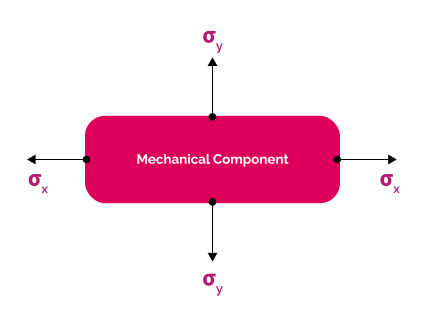
Let us take a look at an exemplary mechanical component, as shown below:
-
The mechanical component is subjected to biaxial stress conditions, and .
-
Consider small elements inside this mechanical component, as shown below:
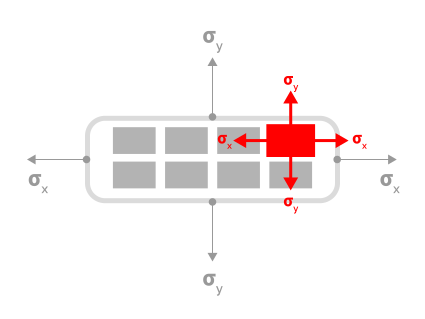
- The rectangle grey boxes inside the mechanical component represent the exemplary small elements inside the mechanical component.
- If you focus on the stress of each of the elements, you will find that the stress is the same, in the horizontal direction and in the vertical direction on every single element of the component.
- One such element is colored red and emphasized to aid in your understanding.
Before we move ahead, let us define the principal plane.
A principal plane is a plane on which only normal stresses will act. In other words, there is no shear stress acting on the plane.
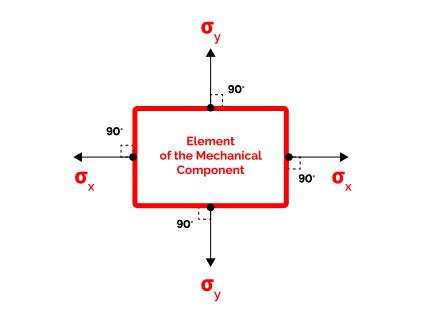
Let us take a look at one of the small elements with unit thickness from the mechanical component, as shown in the figure below:
-
The stresses in the horizontal () and vertical () directions are acting normally (at 90°) to the principal plane; therefore, they both are called normal stresses.
-
Take a look at the same element, which is part of the mechanical component, but this time with additionally applied shear stresses, i.e., acting along the horizontal direction to the vertical direction and acting along the vertical direction to the horizontal direction. If that sounds complicated, don't worry - the article accompanying the shear stress calculator may come to the rescue!
-
The shear stresses are represented with the red dashed arrows along the normal plane, as shown below:
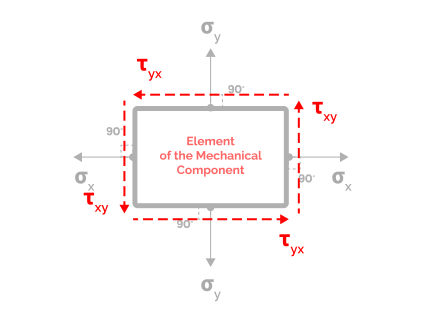
The applied shear rotates the body in an anti-clockwise direction.
The principal plane will lie with an inclination at an angle from the vertical plane inside the surface.
Now, the question arises as to what is principal stress?
The normal stresses acting on the principal plane are called the principal stresses.
What is the principal stress calculation used for?
If any material is brittle in nature, it is going to fail due to the principal stresses and not due to the shear stresses.
Also, the maximum principal stress is responsible for any deterioration of the material.
Therefore, components are designed to withstand the maximum principal stress.
The fracture of the material will take place along the principal plane.
How to use our principal stress calculator
Follow the steps below to use this principal stress calculator with some exemplary values:
-
Enter the normal stress in the horizontal direction, .
-
Input the normal stress in the vertical direction, .
-
Plugin the shear stress, .
-
The shear stress, , has the same amplitude as , but it acts in the opposite direction.
The principal stress calculator will now use the principal stress equations to calculate maximum and minimum principal stresses and the angle of principal stress.
The angle of principal stress is commonly computed in radians.
You can also use our angle converter to get the result in degrees — or simply convert it directly in this principal stress calculator.
Let us take a look at an example of how to use this tool.
Example: If the horizontal stress is 10 MPa, vertical stress is 10 MPa, and shear stress is 8 MPa, we can compute the principal stresses as follows:
-
Input horizontal stress .
-
Input vertical stress .
-
Enter the shear stress .
The calculator will show you the results as follows:
-
The maximum principal stress ;
-
The minimum principal stress ;
-
Angle of principal stress ;
-
Angle of maximum shear stress ; and
-
Angle of minimum shear stress .
Principal stress formula
If you would like to calculate the principal stresses on your own, you can use the principal stress equations presented below:
- The maximum principal stress equation is:
- The minimum principal stress equation is:
- The angle of principal stress is calculated as shown below:
The orientations of maximum shear stress occur at 45° to the principal plane.
- The maximum angle of shear stress is computed as:
- The minimum angle of shear stress is computed as:
FAQs
What does the Principal Stress Calculator do?
This principal stress calculator helps you calculate the amount of normal stress acting on a single major plane. Find the maximum, minimum, and angle of principal stress using this calculator. Use the calculator above for instant results in your browser.
Is the Principal Stress Calculator free to use?
Yes. All Try To Calculator tools are free and do not require an account.
Are my inputs stored or sent to a server?
No. Calculations run locally in your browser. We do not collect the numbers you enter or the results shown.
Can I use the Principal Stress Calculator for professional decisions?
This tool is for education and quick estimates. For medical, legal, tax, or financial decisions, verify results with a qualified professional.
Where can I find related calculators?
Browse more Physics tools on Try To Calculator at /physics, or use the related calculators section on this page.
Formula verified against NIST Reference Data — all calculations use deterministic, standards-based formulas.
Related calculators
Acceleration
Instantly calculate acceleration using acceleration1, acceleration2, acceleration3. Free, accurate physics calculator with real-world examples.
Physics
Density
Instantly calculate density using density, density2, density3. Free, accurate physics calculator with real-world examples.
Physics
Free fall
Instantly calculate free fall using falltime, gravitationalacceleration, height. Free, accurate physics calculator with real-world examples.
Physics
Projectile motion
Instantly calculate projectile motion using distance, horizontalposition, horizontalvelocity. Free, accurate physics calculator with real-world examples.
Physics
Specific heat
Instantly calculate specific heat using q heat, t1, t2. Free, accurate physics calculator with real-world examples.
Physics