
Polar Form Calculator
 Created by Kaushik RabadiyaLast updated: December 5, 2024
Polar form instantly calculates results using imaginary part, magnitude1, phase1. Use the calculator above for instant answers in your browser.
Key takeaway: This polar form calculator helps you perform the conversion form rectangular to polar form. This free Polar Form Calculator is designed for students, teachers, and anyone who needs quick math answers — enter your values above to get instant results.
polar form calculator can help whenever you want to convert a complex number from rectangular to polar form. Scroll down to find a short article explaining what the different forms of a complex number are all about and what the polar form conversion formulas look like. Believe it or not, converting to polar form can be fun!
What are the forms of a complex number?
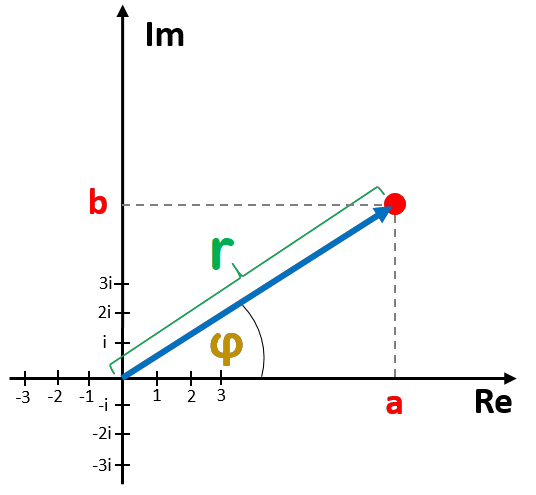
The two main forms of a complex number are polar and rectangular. Usually, you first encounter the rectangular form z = a + bi, where a and b are the real part and imaginary part of z, respectively. They are both real numbers!
The polar form describes z by r × exp(φi), where:
- The magnitude
ris the distance from the origin(0,0)toz; and - The argument
φis the angle between the real axis (x-axis) and the radius connecting the origin(0,0)andz.
Look at the picture to better understand what the polar form is:
How do I convert from rectangular to polar form?
To convert a complex number from the rectangular a + bi to polar form z, we use the formulas:
r = √(a² + b²)
and
φ = atan2(b, a).
If a > 0, then atan2(b, a) = arctan(b / a). However, if a < 0, then atan(b /a) does not give us the correct angle - it must be corrected by ±π to send us into the correct quadrant of the plane. Formally atan2(b, a) is defined as:
atan(b / a)ifa > 0;atan(b / a) + πifa < 0 ≤ b;atan(b / a) - πifa,b < 0;π/2ifa = 0 < b;-π/2ifb < 0 = a; and- remains undefined if
x = y = 0.
These are exactly the formulas behind polar form converter.
How to use this polar form calculator?
To use this polar form converter, take a complex number in the rectangular form a + bi and input a and b into the respective fields of our tool. The two ingredients of the polar form will appear immediately in their fields: the magnitude r and phase (argument) φ. Take them and write down the polar form r × exp(iφ) of your number.
This can't get any easier!
Complex numbers can find you in sooo many areas of science! is well aware of that - we have built a whole collection of tools addressing different problems related to complex numbers. Make sure to check out at least a few of the following tools:
- Complex number calculator;
- a+bi form calculator;
- Multiply complex numbers calculator;
- Divide complex numbers calculator;
- Imaginary number calculator;
- Complex number to polar form calculator;
- Complex number to trigonometric form calculator;
- Complex number to rectangular form calculator; and
- i calculator.
FAQs
What are the forms of a complex number?
The two main forms of a complex number are polar and rectangular. Usually, you first encounter the rectangular form z = a + bi, where a and b are the real part and imaginary part of z, respectively. They are both real numbers! The polar form describes z by r × exp(φi), where: The magnitude r is the distance from the origin (0,0) to z; and The argument φ is the angle between the real axis (x-axis) and the radius connecting the origin (0,0) and z.
How do I convert from rectangular to polar form?
To convert a complex number from the rectangular a + bi to polar form z, we use the formulas: r = √(a² + b²) and φ = atan2(b, a).
How do I convert from trigonometric to polar form?
To convert a complex number from trigonometric to polar form, you need to: Make sure your number is written as z = r × cos(φ) + r × i × sin(φ)]. Extract the magnitude r and the argument φ. Write down your number as r × exp(φi). If in doubt, use an online polar form calculator.
What is the polar form of -1?
The answer is exp(πi). To derive this answer, observe that the modulus (magnitude) of -1 is equal to 1. Next, we must determine φ such that cos(φ) = -1 and sin(φ) = 0. We easily verify that φ = π satisfies these conditions. Hence, the whole number reads 1 × exp(πi), as claimed.
Formula verified against Mathematical standards (ISO 80000-2) — all calculations use deterministic, standards-based formulas.
Related calculators
Remainder
Instantly calculate remainder using dividend, divisor, hidden variables. Free, accurate math calculator with real-world examples.
Math
Slope
Instantly calculate slope using abs b, angle, b. Free, accurate math calculator with real-world examples.
Math
Average
Instantly calculate average using course 1, course 10, course 100. Free, accurate math calculator with real-world examples.
Math
Circumference
Instantly calculate circumference using area, circumference, d. Free, accurate math calculator with real-world examples.
Math
Right triangle side and angle
Instantly calculate right triangle side and angle using a1, a2, a3. Free, accurate math calculator with real-world examples.
Math