
Inverse Variation Calculator
 Created by Kaushik RabadiyaLast updated: October 29, 2024
Inverse variation instantly calculates results using k, x, y. Use the calculator above for instant answers in your browser.
Key takeaway: Use this inverse variation calculator to understand and compute the inverse proportionality between two variables. This free Inverse Variation Calculator is designed for students, teachers, and anyone who needs quick math answers — enter your values above to get instant results.
Our inverse variation calculator is here to help you observe two variables inversely proportional to each other. If you have two parameters that depend on each other and wish to check whether they vary inversely, you've come to the right place!
In this companion article, we shall briefly look at calculating inverse proportionality, including:
- What is an inverse variation?
- Inverse variation equation.
- Inverse variation examples.
- Some FAQs.
You can also assess the direct variation between two variables with our direct variation calculator.
Inverse variation equation of two variables
We say two variables are inversely varying (or inversely proportional) if an increase in one variable results in a proportional decrease in the other.
We can write the inverse proportion between two variables as:
where:
- – A dependant variable; and
- – An independent variable.
Note that must be non-zero. Using a constant of proportionality , we can get the formula for inverse variation as:
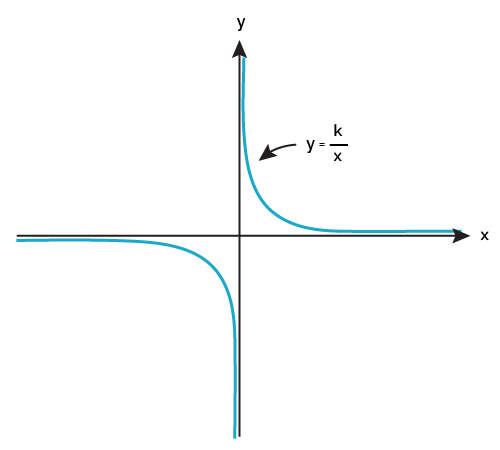
Naturally, inverse proportionality graphs reflect a reciprocal function.
How do you calculate the proportionality constant of inverse variation?
Once you've determined that two variables, x and y, are inversely proportional, calculating their proportionality constant is easy:
- Multiply the variables
xandyto getk = x · y. - Verify your answer with inverse variation calculator.
Examples of inverse variation
Let's look at a few examples of inverse variation in real life:
- Speed and time: The speed of an object is inversely proportional to the time it needs to cover a given distance. A car moving at 60 mph will take 100 minutes to cover 100 miles, whereas a vehicle moving at 50 mph will need 120 minutes to cross the same distance.
- Newton's law of gravitational force: The gravitational force between two masses is inversely proportional to the square of the distance between them. So if an Earth-sized planet orbits the Sun at a larger distance than us, it would feel a weaker gravitational pull than we do.
For more on gravitational force, head to our gravitational force calculator.
- Coulomb's law: Similar to the gravitational force, the electromagnetic force between two charged particles is inversely proportional to the square of the distance between them.
You can learn more about this force with our Coulomb's law calculator.
How to use this inverse variation calculator
This inverse variation calculator requires only two inputs from you:
- The independent variable ; and
- The constant of inverse variation .
From these two values, this inverse variation equation calculator will give you the following outputs:
- The dependent variable ; and
- If , the calculator will also show you a graph of the inverse variation, so you can visually assess the variation.
But you don't need to hold back – You can enter any two knowns into this inverse proportion calculator to find the remaining unknown.
FAQs
How do you calculate the proportionality constant of inverse variation?
Once you've determined that two variables, x and y, are inversely proportional, calculating their proportionality constant is easy: Multiply the variables x and y to get k = x · y.
How do you recognize inverse variation?
Recognizing inverse variation between two variables is possible once you have multiple values: Collect the values of these variables at multiple data points to get: (x1, y1), (x2, y2), (x3, y3),.... Multiply the x-term of each data point with its corresponding y-term, to get: (x1 · y1), (x2 · y2), (x3 · y3),.... To tell if the variables vary inversely or not: If the result is constant, i.e., if (x1 · y1) = (x2 · y2) = (x3 · y3)...., the variables vary inversely. If the result keeps varying, the variables do not vary inversely.
What is *y* in the inverse variation *y = 14/x*, at *x = 4*?
y = 3.5. These steps will help you arrive at the same conclusion: Use x = 4 in the inverse variation equation y = 14/x to get y = 14/4. Solve the inverse variation equation to get y = 3.5. Verify the result with our inverse variation calculator.
Which axis does the graph of inverse proportionality cross?
The graph of inverse proportionality cannot cross or intersect any axis. Looking at the inverse variation equation y = k/x, we can see that neither x nor y can be zero.
Formula verified against Mathematical standards (ISO 80000-2) — all calculations use deterministic, standards-based formulas.
Related calculators
Remainder
Instantly calculate remainder using dividend, divisor, hidden variables. Free, accurate math calculator with real-world examples.
Math
Slope
Instantly calculate slope using abs b, angle, b. Free, accurate math calculator with real-world examples.
Math
Average
Instantly calculate average using course 1, course 10, course 100. Free, accurate math calculator with real-world examples.
Math
Circumference
Instantly calculate circumference using area, circumference, d. Free, accurate math calculator with real-world examples.
Math
Right triangle side and angle
Instantly calculate right triangle side and angle using a1, a2, a3. Free, accurate math calculator with real-world examples.
Math