
Cos Inverse Calculator
 Created by Kaushik RabadiyaLast updated: January 30, 2026
Cos inverse instantly calculates results using x, y. Use the calculator above for instant answers in your browser.
Key takeaway: The cos inverse calculator allows you to quickly evaluate the values of the arcus cosine function. This free Cos Inverse Calculator is designed for students, teachers, and anyone who needs quick math answers — enter your values above to get instant results.
The cos inverse calculator will help you deal with problems that require inverting the cosine function. It can't be any simpler: give us a number (between -1 and 1!), and we'll evaluate the cos inverse of this value. Why must the number be between -1 and 1? Read on to learn some theory behind the cos inverse, in particular, understand its domain and range or see how to compute the cos inverse of negative values.
What is the cos inverse function?
The cos inverse is the inverse of the cosine function (no surprises here). That is, the cos inverse finds the angle that produces a particular cosine value. We denote this function by arccos, and we have the following formula:
arccos(x) = y if and only if x = cos(y)
for x ∈ [-1, 1].
This last condition describes the domain of cos inverse. We'll discuss it now and then move on to the range.
What is the domain of cos inverse?
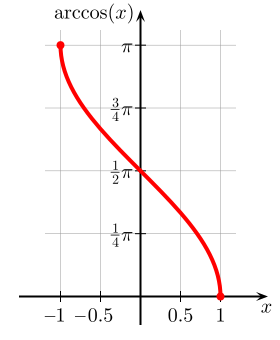
The domain of the cos inverse is [-1, 1]. In other words, you can calculate cos inverse only for values between -1 and 1. Why? Recall that the range of a function becomes the domain of its inverse. As the cosine has values between -1 and 1, this interval is the domain of the cos inverse.
What is the range of cos inverse?
The range of cos inverse is the interval [0, π] in radians, or [0,180°] in degrees. Why? As you most certainly remember, the cosine is a periodic function; in particular, it is many-to-one. We cannot invert such functions! First, we must restrict it to an interval where the function is one-to-one. For the cosine, we most often restrict to the interval [0, π]. This is why this interval is the range of the cos inverse.
To better memorize the above results, take a look at the cos inverse graph:
How to use this cos inverse calculator
Our tool is extremely easy to use: you input an argument x, and the value of arccos(x) appears immediately.
But please remember what you've learned about the domain of cos inverse! You must not enter values that do not satisfy the condition -1 ≤ x ≤ 1. Otherwise, the universe will explode. (Joking, our calculator will simply refuse your input, saving the universe. Try and see.)
Satisfied with the results returned by our cos inverse calculator? As inverse trig functions are quite tricky to deal with, we've built several tools around this topic:
FAQs
What is the cos inverse function?
The cos inverse is the inverse of the cosine function (no surprises here). That is, the cos inverse finds the angle that produces a particular cosine value. We denote this function by arccos, and we have the following formula: arccos(x) = y if and only if x = cos(y) for x ∈ [-1, 1].
What is the domain of cos inverse?
The domain of the cos inverse is [-1, 1]. In other words, you can calculate cos inverse only for values between -1 and 1. Why? Recall that the range of a function becomes the domain of its inverse. As the cosine has values between -1 and 1, this interval is the domain of the cos inverse.
What is the range of cos inverse?
The range of cos inverse is the interval [0, π] in radians, or [0,180°] in degrees. Why? As you most certainly remember, the cosine is a periodic function; in particular, it is many-to-one. We cannot invert such functions! First, we must restrict it to an interval where the function is one-to-one. For the cosine, we most often restrict to the interval [0, π]. This is why this interval is the range of the cos inverse.
How do I calculate the cos inverse of negative numbers?
To compute the cos inverse of a negative number -x: Determine the absolute value of your number (i.e., remove the minus sign): x. Compute the cos inverse of the value from Step 1: arccos(x). You may want to use an online cos inverse calculator to do that. Subtract the value obtained in Step 2 from π, i.e., compute π - arccos(x). This is your answer! We've used here the formula arccos(-x) = π - arccos(x).
What is the cos inverse of zero?
The answer is 90°, that is, π/2 rad. One way to get this result is to reformulate the question and ask what is the angle that lies in the interval [0, π] and its cosine is zero? It may help to sketch the cosine graph (the usual wavy stuff) and check where it crosses the x-axis. A quick look at this graph will tell you that the angle we're looking for is indeed the correct angle.
Formula verified against Mathematical standards (ISO 80000-2) — all calculations use deterministic, standards-based formulas.
Related calculators
Remainder
Instantly calculate remainder using dividend, divisor, hidden variables. Free, accurate math calculator with real-world examples.
Math
Slope
Instantly calculate slope using abs b, angle, b. Free, accurate math calculator with real-world examples.
Math
Average
Instantly calculate average using course 1, course 10, course 100. Free, accurate math calculator with real-world examples.
Math
Circumference
Instantly calculate circumference using area, circumference, d. Free, accurate math calculator with real-world examples.
Math
Right triangle side and angle
Instantly calculate right triangle side and angle using a1, a2, a3. Free, accurate math calculator with real-world examples.
Math