
Olympic Games Sustainability Calculator
 Created by Kaushik RabadiyaLast updated: August 13, 2024
Olympic Games sustainability instantly calculates results using olympicsgame, ecological score, economical score. Use the calculator above for instant answers in your browser.
Key takeaway: Use the Olympic Games sustainability calculator to find out how sustainable the Olympic Games are ecologically, socially, and economically. This free Olympic Games Sustainability Calculator is designed for environmentally conscious individuals, researchers, and sustainability planners — enter your values above to get instant results.
The Olympic Games sustainability calculator uses the Olympic Sustainability Model to show you exactly how sustainable the Olympic Games really are (or at least give you approximate estimates). The tool will answer all your questions about the Olympic Games' economic, social, and ecological impact.
Keep exploring our Olympic Games sustainability calculator and article to find out more about the Olympic Sustainability Model, how to calculate the sustainability score, what it implies, what is a good sustainability score and how to make the Olympics more sustainable.
What is the Olympic sustainability model?
Since 1992, the International Olympic Committee (IOC) has included sustainability as the Olympics's third green dimension. Following several Olympic events with sustainable strategies from the IOC, Müller et al. developed an Olympic sustainability model in 2021 behind "An evaluation of the sustainability of the Olympic Games" as a systematic evaluation of the Olympic Games' sustainability across three dimensions: ecological, social, and economic.
Below, we give you a brief overview of each of the dimensions and what they include.
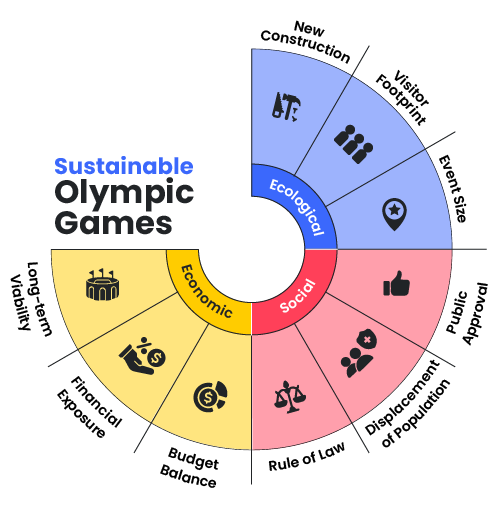
Ecological dimension
This encompasses the ecological and material footprint of the event, including:
-
New construction — Raw materials and resources needed to build or renovate venues.
-
Event size — The number of persons accredited and the relation to the venue's use.
-
Visitor footprint — Fuel spent on transportation to and from the events or the space required to accommodate all the participants.
💡 The higher the amount of athletes and visitors, the higher the number of flights and other modes of transport that will be used. Visit our flight carbon footprint calculator and car vs. bike calculator to calculate their emissions.
Social dimension
The social dimension of the Olympic Games evaluates how the event accommodates the needs of the host city's population and its impact on marginalized communities:
-
Public approval — Public support for the event based on poll respondents.
-
Social safety — The number of displaced people due to the event.
-
Rule of law — Extent of severity of law and legislation changes.
🙋 Actions such as the banning of demonstrations, drone surveillance, and police or military occupation seen in Paris during the 2024 Olympics, for instance, could substantially lower its social dimension score.
Economic dimension
Economic efficiency measures how effectively funds are used for hosting the Olympic Games:
-
Budget balance — Cost overruns and how this amount could fund other projects.
-
Financial exposure — Proportion of public funding being used to fund the Olympics instead of other potentially more beneficial investments.
-
Long-term viability — Amount of reusable venues, and the avoided 'white elephants'.
🔎 Sochi 2014 was the most expensive Olympic game, estimated to have cost around US$50 billion. How well do you think this game performed in terms of efficiency?
Olympic games sustainability calculator — How to calculate sustainability score?
The Olympic sustainability score is based on a 0 to 100 score system where 100 indicates the best possible outcome (e.g., minimal impact or highest efficiency), and vice versa.
Let's take the Barcelona 1992 Olympics as an example:
| Dimension | Criteria | Score |
|---|---|---|
| Ecological | New construction | 20 |
| Visitor footprint | 100 | |
| Event size | 100 | |
| Social | Public approval | 100 |
| Social safety | 0 | |
| Rule of law | 80 | |
| Economic | Budget balance | 0 |
| Financial exposure | 20 | |
| Long-term viability | 80 |
So, to calculate each dimension's sustainability score, you have to average them out:
...and then normalize the results so that the maximum value for the sum of the dimensions is always 100:
💡 If you need a more detailed explanation of how the normalization is done, check out our mean absolute deviation calculator!
Easy, right? Now, to calculate the total Olympic sustainability score, you add up the numbers for each dimension:
That's it! It wasn't so hard after all. Calculating how sustainable an Olympic game is made simple with our Olympic sustainability games calculator. However, if you are a curious and inquisitive person, you may wonder about the origin of those initial indicator values and how they were obtained.
Well, fret no more, for here comes the answer! To learn more about the scoring system and what criteria were used, check out the study's supplementary materials.
Summer vs. Winter Olympics
As you select the Olympic Games, the Olympic Games sustainability calculator will tell you whether the event hosts summer ☀️ or winter ❄️ games. Notice how this factor affects the rest of the provided information.
Here are some notable differences between the two:
-
Winter Olympics have a smaller visitor footprint as there are fewer attendees.
-
Winter Olympics require a smaller portion of the urban infrastructure, displacing and affecting fewer people.
-
Summer Olympics have more long-term viability in terms of reusable venues.
-
Summer Olympics gain more public approval and support possibly due to a higher share of the population involved.
However, this does not necessarily mean that the Winter Olympics are more sustainable than the Summer ones, as Sochi 2014's least sustainable event proves.
Interestingly, Winter Olympics appear to have a lower amount of estimated CO2 emissions. You can peek at our Keya identity calculator for a more in-depth article on CO2 emissions from human sources
How sustainable was the Paris 2024 Olympics?
Now that you know how to calculate the Olympic sustainability score, you may wonder about the Paris 2024 Olympics. How sustainable was the Paris 2024 Olympics?
The Paris 2024 Olympics' sustainability score is 40/100, which is not the best range. This would rank it 11th on the Olympic Games' sustainability podium.
| Rank | Olympic games | Sustainability score | CO2 emission (Mt CO2 eq) |
|---|---|---|---|
| 1 | 🇺🇸 Salt Lake City 2002 | 71 | 1.9 |
| 2 | 🇪🇸 Barcelona 1992 | 55.56 | n/a |
| 3 | 🇫🇷 Albertville 1992 | 53.33 | 1.6 |
| 4 | 🇰🇷 PyeongChang 2018 | 53.33 | 1.9 |
| 5 | 🇮🇹 Torino 2006 | 51.11 | 2.5 |
| 6 | 🇺🇸 Atlanta 1996 | 51.11 | 2.7 |
| 7 | 🇦🇺 Sydney 2000 | 51.11 | 3.3 |
| 8 | 🇨🇦 Vancouver 2010 | 48.89 | 3.1 |
| 9 | 🇨🇳 Beijing 2008 | 46.67 | 1.36 |
| 10 | 🇬🇷 Athens 2004 | 44.44 | 3.5 |
| 11 | 🇫🇷 Paris 2024 | 40 | 1.75 |
| 12 | 🇳🇴 Lillehammer 1994 | 40 | 2.0 |
| 13 | 🇯🇵 Nagano 1998 | 40 | 2.1 |
| 14 | 🇬🇧 London 2012 | 40 | 3.4 |
| 15 | 🇨🇳 Beijing 2022 | 33.33 | 3.9 |
| 16 | 🇯🇵 Tokyo 2020 | 31.11 | 2.3 |
| 17 | 🇧🇷 Rio de Janeiro 2016 | 28.89 | 3.6 |
| 18 | 🇷🇺 Sochi 2014 | 24.44 | 3.3 |
The lowest aspect of the Paris 2024 Olympics is the social score of 26.67/100, mainly because of the eviction of up to 12,000 people and severe legal restrictions. Ecologically speaking, it is expected not to score high due to the enormous event size, the audience, and the conflicting delivery of the surfing events in Tahiti. Lastly, it is doing quite well economically, with venues intentionally built for long-term use in an eco-friendly manner.
Although, considering the estimated CO2 emission of 1.75 Mt CO2 eq, the Paris 2024 Olympics will emit the least carbon than any Olympic year in history except for the Beijing 2022 Olympics with an emission of 1.36 Mt CO2 eq.
Anyhow, it might still be too early to say. Let's be patient and let time do its work.
FAQs
How do we make the Olympics more sustainable?
To make the Olympic games or any other mega-events more sustainable, the following actions should be applied: Controlling the amount of visitors. Reducing the event size. Circulating the event locations in the same host cities. Enforcing sustainable practices and standards.
Which was the most sustainable Olympic Games?
According to the Olympic sustainability model, the 2002 Salt Lake City Winter Olympics was the most sustainable event, with a total score of 71/100.
Which was the least sustainable Olympic Games?
The least sustainable Olympic event was the 2014 Sochi Winter Olympics, which scored an average of 24/100, with particularly low performance in the economic category. Rio de Janeiro’s 2016 Summer Olympics also scored poorly, at 29/100, largely due to social disruptions and poor post-event use of venues.
What is the IOC sustainability strategy?
The IOC sustainability strategy, launched in 2017, is a framework by the International Olympic Committee to embed sustainability into all aspects of the Olympic Games and the Olympic Movement, aligning with the UN's Sustainable Development Goals (SDGs).
What is a good sustainability score?
The sustainability score of 75 is the minimum threshold of a completely sustainable Olympic event. Requirements to achieve this range include effective management in terms of ecological, social and economic impacts.
Based on 3 sources
- An evaluation of the sustainability of the Olympic Games — Martin Müller, Sven Daniel Wolfe, Christopher Gaffney, David Gogishvili, Miriam Hug & Annick Leick.
- The Oxford Olympics Study 2024: Are Cost and Cost Overrun at the Games Coming Down? — Alexander Budzier & Bent Flyvbjerg.
- Sustainable Legacies of a Climate Positive Olympic Games: An Assessment of Carbon Offsets and Renewable Energy for Brisbane 2032 — Anthony P. Heynen & Prabhakaran Vanaraja Ambeth.
Formula verified against EPA environmental data — all calculations use deterministic, standards-based formulas.
Related calculators
Plastic footprint
Instantly calculate plastic footprint using pet bottles, bags, bath bottles. Free, accurate ecology calculator with real-world examples.
Ecology
Wind turbine
Instantly calculate wind turbine using air density, area, area vawt. Free, accurate ecology calculator with real-world examples.
Ecology
Shannon diversity index
Instantly calculate shannon diversity index using a1, a10, a11. Free, accurate ecology calculator with real-world examples.
Ecology
Solar panel
Instantly calculate solar panel using area of panel, bill offset percentage, cost per kwh. Free, accurate ecology calculator with real-world examples.
Ecology
Hydroelectric power
Instantly calculate hydroelectric power using area, discharge, efficiency. Free, accurate ecology calculator with real-world examples.
Ecology